Space Hall Explosion
Break Down



Create an explosive Pyro-driven simulation with dynamic fire spreading across targeted material types. Materials, imported from Maya into Houdini, are used to split the FBX into their respective networks.

Broad material groups (metal, lightMetal, lights, cables, plastic, padding, fabric, etc.) were assigned to meshes. UV unwrapping wasn’t required and topology precision was de-prioritized.

Geometry is re-meshed inside Houdini to achieve the correct scale.
This workflow lets any FBX with correct material naming be imported into the network with minimal modification.

Here is the fbx once inside Houdini and brought through my network.

Karma XPU renders of the explosion.


The process flows left to right.
First the GEO is imported > then it is brought into the SIM for caching > and finally it is brought into LOP rendering in Karma XPU

Here the FBX is imported into GEO.
I split the geometry based on their material assigned from MAYA.
I then modify the geometry and normals before applying a clean.
Everything is merged into a group to await fracturing.

Fracturing takes place from a point id attribute transfer origination from a sphere (overlap_geo).
These points designate on the topology where to concentrate fracturing.
This allows for a dynamic fracture source that I can move anytime with ease.

The green box is an anchor foundation to attach an unbreakable constraint later.
This way the vellum SIM does not fly away into space and stays central to the scene.
Everything is then cached into a single file for permanent save.

This cached file is then imported into the SIM.
Vellum cloth and weld points are then designated tot he respective material types.
A major portion of this SIM takes on velocities origination from a PYRO burst source on the right.
This source is centered from the fracture origin location. It is always where the fracturing takes place.
The burst velocities are calculated and transferred onto v and scaled by the attribute wrangler in green.
Now the geo is taking on the velocities of the explosion before getting solved.

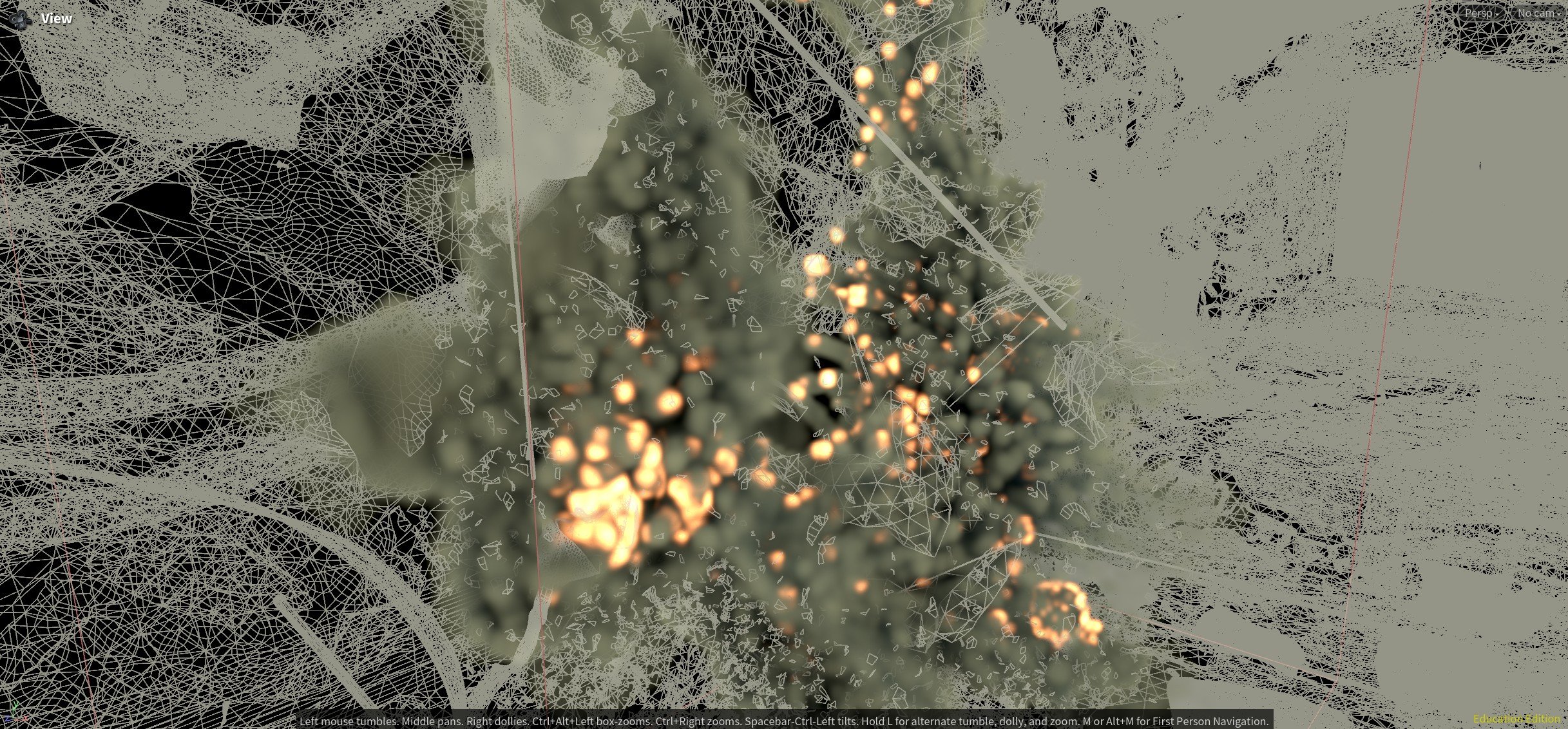
Vellum is solved and cached for the frame range.
The vellum geo is packed and converted to VDB for quick collision calculation.
These collisions are brought into the explosion solver to ensure no clipping of the explosion and the vellum.
The vellum is then split into flammable primitives only by that material group.
We then bring in the baked and cached PYRO explosion volume as a primitives. These primitives become source overlaps for the fire spread.
I am using group creation and attribute creation to signify which points are and aren’t on fire.
These attributes drive the spread of the fire and track only to flammables.

Here are the network details at the top import geo for the SIM level.

Here everything is brought into the LOP structure and prepared for Karma XPU.